What is NVQ?
Under the higher educational system in Sri Lanka, bachelor degrees in Arts, Science, Commerce and all other areas are offered under the purview of UGC (University Grants Commission) to maintain the uniformity and the recognition irrespective of the university or the offering body.
This process is well established in Sri Lanka for Academic Education. As a matter of fact, Academic Education is not for vocational or professional purposes, but for research and respective higher studies. Unfortunately, Academic Educational opportunities are limited to the maximum of 10%-15% of students who are successfully completing A/L exams.
In A/L examination, over 200,000 students and in O/L examination over 100,000 students get drop-out each year, these students are unable to find a proper channel to acquire a higher level qualification or gain relevant experience to enter the job market. Most of the students are wasting their precious time and money by facing A/L examination two or three times. Consequently, students who become exhausted with their repeated A/L examinations may enter the unskilled job market with lower salary scales.
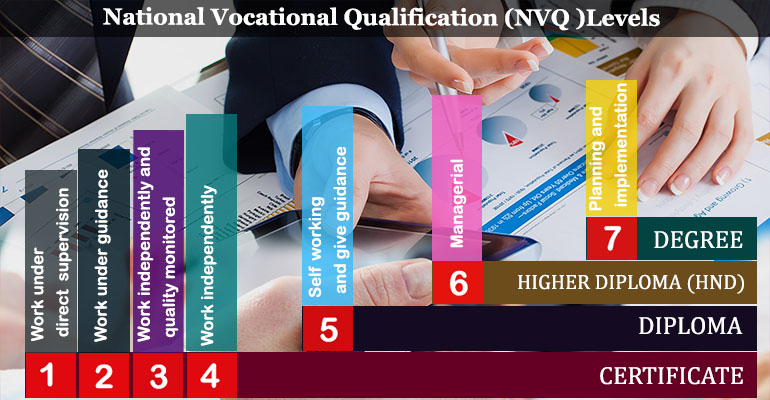
As a result, to overcome the issues discussed above, the Tertiary and Vocational Education Commission (TVEC) has taken necessary steps to introduce the National Vocational Qualification (NVQ) System with 7 Levels. The NVQ level 7 is equivalent to the bachelor degree qualification.
Students can enrol into the M.Sc. or any other postgraduate programme after completion the NVQ level 7. Students who have successfully completed NVQ level 5, can enter for the 2nd year in most of the foreign universities where the relevant field is available.
Compared to the academic qualifications, the NVQ is designed for the job seekers soon after their A/L exams. The speciality of the NVQ system is that, at the completion of each level of the NVQ qualification, candidates become eligible to enter the professional job market with fairly higher salary scales than the academic qualification holders.
The Vocational Training Authority (VTA) under the Ministry of Science, Technology, Research, Skills Development & Vocational Training and Kandyan Heritage, is in the process of implementing the NVQ system very successfully.
Many developed and developing countries in the world have introduced vocational skills certification systems similar to the NVQ system. As such, the NVQ system is in real practice and quite familiar to the authorities in most of the countries. Therefore, the National Vocational Qualification System is nationally and internationally recognised in order to enter the global job market as qualified professionals.
How Could One Get Qualified with NVQ?
Method 1: Recognition of Prior Learning (RPL)
If the candidate could prove his/her ability with adequate evidence of his/her competencies pertaining to qualifications stipulated in the Skills Standards, then the candidate is eligible to receive NVQ certificate through RPL (Recognition of Prior Learning).
Contact Mrs. Pradeepika Ranasinghe - 0710318722
Method 2: Competency Based Training (CBT)
The other method of getting NVQ certificate is by following a Competency Based Training (CBT) course relevant to the qualification. A candidate can follow a NVQ based training program at Vocational Training Authority or in other public and private institutes which are accredited to issue NVQ certificates.
Advantages of NVQ System
- Skills Certification: NVQ Certificate is not just a certificate to assure knowledge about the subject. It is a certificate that certifies your skills. It is an internationally recognized certificate confirming that you possess skills up to the respective NVQ level to work productively in the relevant profession.
- Career Growth: Skills are automatically gained through the career growth, experiences and competencies which will facilitate to obtain higher level of NVQ qualifications.
- Foreign Employment: NVQ system is a skills evaluation system which has a higher tendency to obtain foreign employment.
- Industry Ready: Since the skills standards are prepared with the contribution and approval of professionally competent personnel in the industry, such skills are sufficient to carry out the relevant functions in the Industry. Therefore, it becomes easier for the NVQ certificate holders to enter the job market as professionals.
- Continuous Development: If NVQ certificate recipients are enthusiastic to gain higher qualifications while working, the system encourages employers to upgrade their career development.
- Industry-Ready Workforce: All skills required for relevant Industries are identified and imparted with the NVQ qualification. Therefore, a candidate who is certified with the NVQ system becomes a best fit to be employed at any organization.
- Recruitment & Promotion Tool: NVQ qualification will not only be the best future tool to measure skill requirements for the recruitment of professionals for any organization but also for promotions and to offer higher salaries etc.
Quick Facts
7 Levels
NVQ Level 7 = Bachelor Degree
International Recognition
Accepted worldwide for employment
Job Ready
Enter job market at each level